O R I G I N
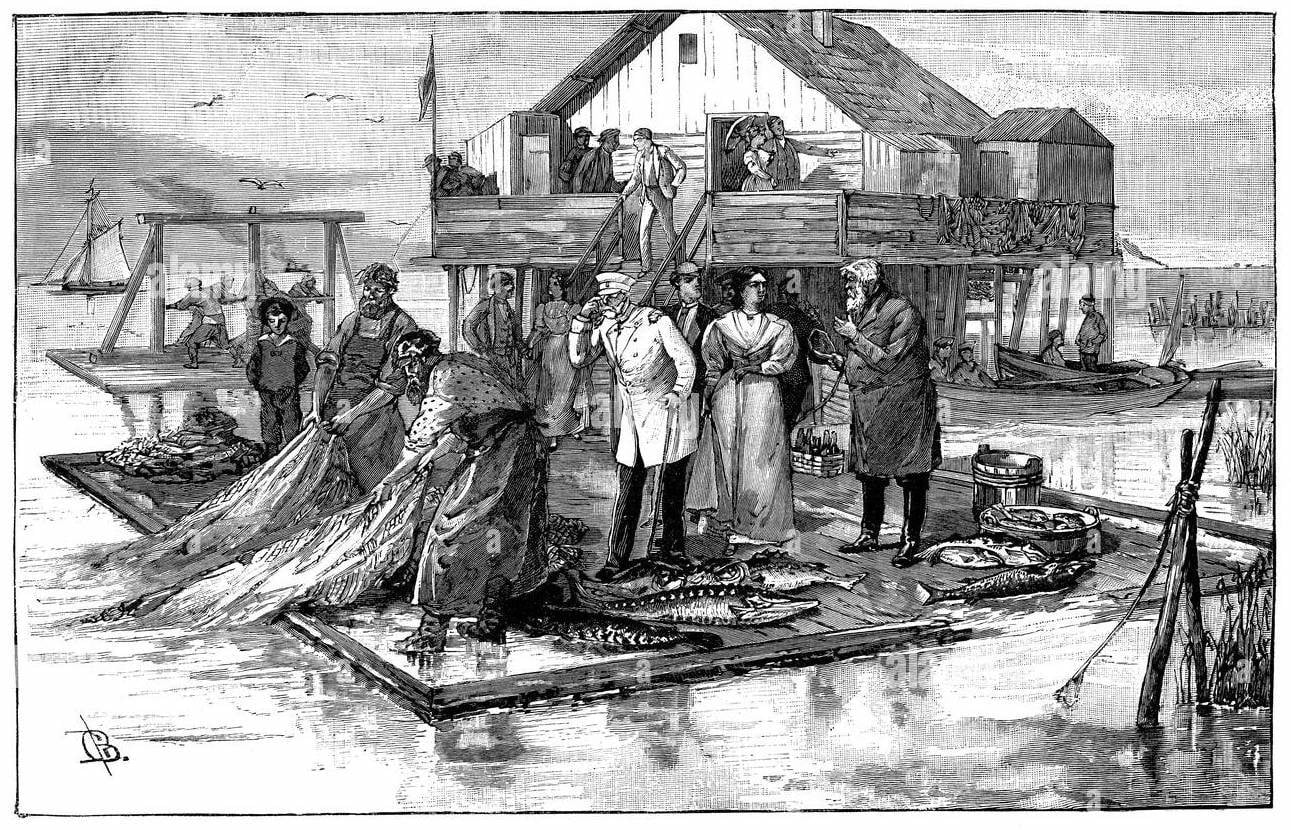
Cossacks, Turks, Persians… This delicacy has been attributed with various origins and qualities since antiquity. The Cossacks, the first people to consume it, believed it enhanced physical strength, while in Ancient Rome, it was attributed with healing properties.
Although its consumption is documented since the era of Catherine the Great in the late 18th century, it was not until 1917 that it gained widespread popularity across Europe during the Russian Revolution. Aristocrats fleeing the country arrived in Paris and Monte Carlo, where they served sturgeon roe at high society dinners and parties. It was at this point that caviar began its journey as a luxury product.
THE 2000s: THE HEYDAY OF CAVIAR
Given the progressive decline of sturgeon populations in their natural habitat, the Washington Convention declared all species of the family to be threatened. Ultimately, since 2008, fishing for them in the Caspian Sea has been completely prohibited.
Since the 1990s, aquaculture farms began to develop. Petrossian has played a significant role in their success, guiding them and sharing its expertise to produce farmed caviar with qualities and flavors as close as possible to wild caviar.
Currently, aquaculture farms are proliferating internationally: in the United States, France, Italy, China, Israel, Bulgaria, Poland, and other countries.
The location where the fish are raised has little impact on caviar quality; it is the sturgeon species from which the caviar originates that determines its uniqueness. The precise salting, maturation, and meticulous selection of the grains are unique to each sturgeon species, and it is from this unique expertise that Bolshoi caviar is born.
Since the 1990s, aquaculture farms began to develop. Petrossian has played a significant role in their success, guiding them and sharing its expertise to produce farmed caviar with qualities and flavors as close as possible to wild caviar.
Currently, aquaculture farms are proliferating internationally: in the United States, France, Italy, China, Israel, Bulgaria, Poland, and other countries.
The location where the fish are raised has little impact on caviar quality; it is the sturgeon species from which the caviar originates that determines its uniqueness. The precise salting, maturation, and meticulous selection of the grains are unique to each sturgeon species, and it is from this unique expertise that Bolshoi caviar is born.

